
Abortion Is Fine
The philosophical and scientific case that almost nobody makes clearly

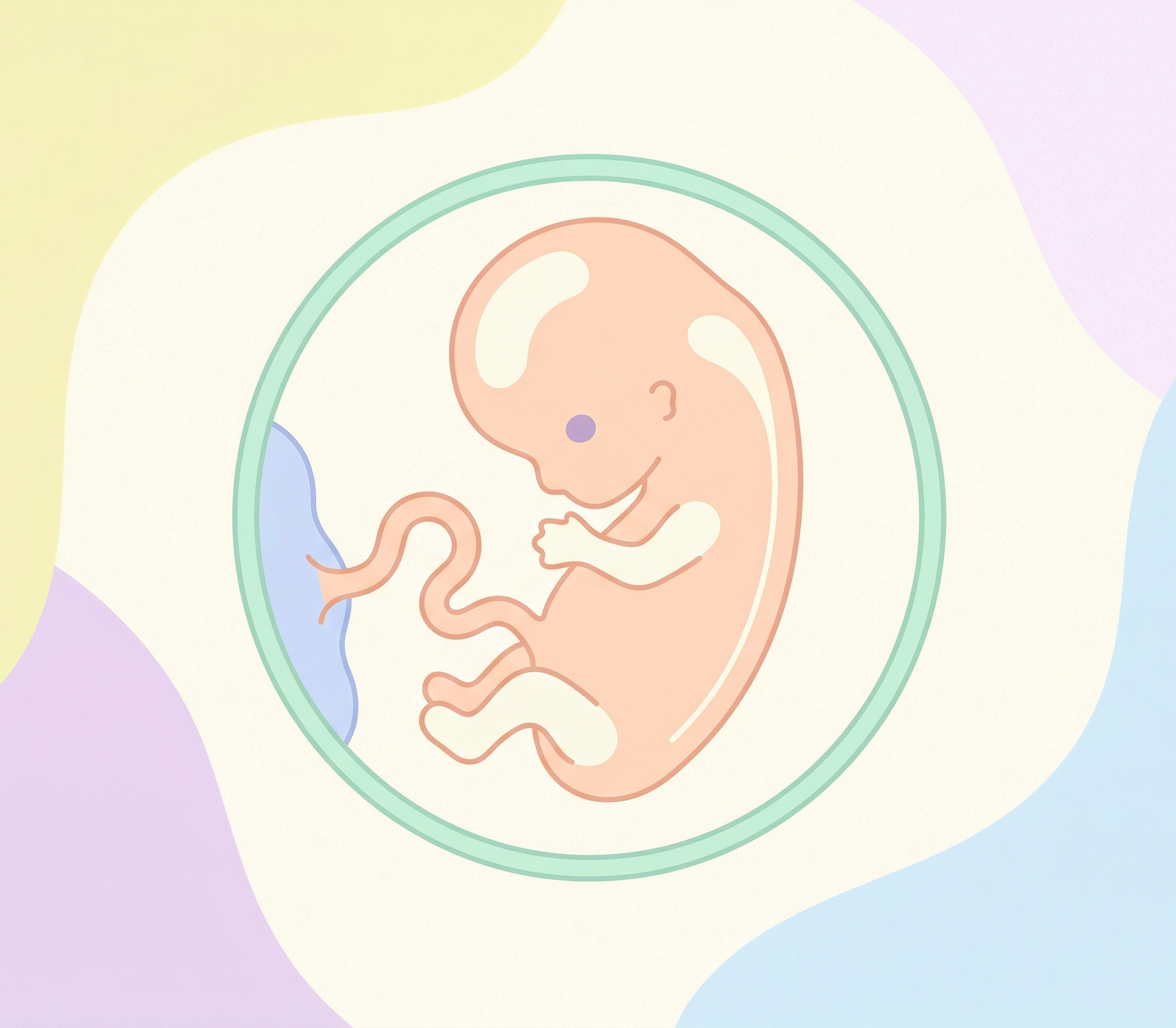
A first-trimester abortion, the kind that accounts for roughly 93% of all abortions performed in the United States, is about as morally significant as removing a mole.
I know this sounds unhinged. But I think the abortion question, on the merits, is not close, and I think most people who’ve spent real time with the philosophical arguments agree, even the ones who frame their conclusions diplomatically. The culture-war version of this debate treats it as a 50-50 clash of irreconcilable values, where reasonable people simply disagree and the best we can hope for is an uneasy truce. That framing is wrong. Not because the opposing side doesn’t have any arguments (it does, and I’ll take the best ones seriously), but because when you follow those arguments to their conclusions, they either collapse under their own weight or prove far too much to be useful at all.
The Question Everyone Gets Wrong
The abortion debate is usually framed around the question “when does life begin?” This is the wrong question. It has always been the wrong question.
A sperm cell is alive. An egg cell is alive. A skin cell you scratch off your arm is alive. A bacterium in your gut is alive. “Life” is not a morally interesting category. The question is not whether something is biologically alive but whether it is the kind of thing that has interests, that can be harmed, that possesses what philosophers call moral status. In ordinary language: is it a person?
And here the debate gets interesting, because the word “person” is doing enormous work and almost nobody stops to notice the equivocation. The anti-abortion syllogism looks airtight:
It is wrong to kill innocent persons.
A fetus is a person.
Therefore, it is wrong to kill a fetus.
The problem, as Mary Anne Warren pointed out in 1973, is that “person” in premise 1 and “person” in premise 2 mean completely different things. In premise 1, “person” means a moral person: a being with consciousness, the capacity to feel pain and suffer, the ability to reason, some form of self-concept. This is the sense in which killing a person is wrong. In premise 2, “person” just means a member of the species Homo sapiens: a biological human. And while a first-trimester embryo is certainly a biological human (it has human DNA, it is the offspring of human parents), it is, by any reasonable accounting of the relevant features, not a moral person.
This is almost boringly standard in philosophy. We can see it by asking a simple test question: if you encountered an alien species that had consciousness, could feel pain, could reason, could communicate, and had self-awareness, would you think it was wrong to kill one of them? Obviously yes. You wouldn’t even hesitate. And that alien doesn’t share a single strand of human DNA. What makes killing wrong is having the kind of inner life that gives you a stake in your own continued existence.
What a First-Trimester Embryo Actually Is
The abortion debate too often takes place at the level of abstractions and euphemisms on both sides.
At the time most abortions occur (which, again, is overwhelmingly in the first 13 weeks of pregnancy), the embryo is, from a neuroscientific standpoint, not the kind of entity that can plausibly be a subject of awareness.
The neural tube, which will eventually become the brain and spinal cord, closes around week 5-6 of pregnancy. The first synapses in the spinal cord appear around weeks 7-8. But these are reflex arcs. The embryo at 8 weeks, often the subject of photographs in anti-abortion pamphlets (it is about the size of a raspberry), has a structure that will become a brain in the same way that a blueprint is a house. The basic hardware for even the most primitive form of sensation is simply not wired up at all.
The cerebral cortex, the part of the brain responsible for anything resembling conscious perception, does not begin to form functional connections until roughly 24 to 28 weeks of gestation. These thalamocortical connections are, based on the best available neuroscience, the minimum structural prerequisite for any form of awareness, including pain. Before they exist, there is no “someone home.” Reactions to stimuli are reflexive, in the way that a decapitated frog’s legs twitch when you apply an electrical current: the response happens at the spinal level without any signal ever reaching a brain capable of registering it.
The American College of Obstetricians and Gynecologists has stated that the science does not support fetal pain perception before 24-25 weeks. Individual researchers have pushed back on this, suggesting that subcortical structures might permit some rudimentary form of sensory response slightly earlier, perhaps around 20-22 weeks. I take this disagreement seriously. Even on the most generous reading of the evidence, accepting the minority view that some form of pain response might be possible after 20 weeks, this is still after far more than 93% of abortions have already occurred. The first trimester, where the vast majority of abortions take place, is not a gray area. There is no plausible neuroscientific case that a 10-week fetus feels anything at all. It is not a person.
For context: the entity we’re discussing at 10 weeks weighs about 4 grams. It has no functioning cerebral cortex. It has no thalamic connections to interpret sensory input. It has the computational complexity of, generously, a shrimp. If you believe a 10-week fetus has equivalent moral status to a newborn baby, or to you, you need a reason other than its current mental capacities, because it has effectively none.
The Twinning Problem (Or: Why Conception Isn’t the Magic Moment)
The most common anti-abortion position claims that personhood begins at conception. Putting aside the neuroscience for a moment, there’s a strictly logical problem with this view that is almost never discussed publicly.
Monozygotic (identical) twins form when a single embryo splits into two, usually within the first 14 days after fertilization. This is not rare; about 3-4 per thousand births are identical twins. Now, if personhood begins at conception, then at the moment of fertilization we have one person. A few days later, that one person has become two. What happened? Did one person die and two new ones appear? Did the original person survive and a new person bud off? Which twin is the “original”? The question is unanswerable because it is incoherent. The very concept of stable individual identity does not apply to an entity that can split into two organisms. And if individual identity does not apply, neither does personhood, because personhood requires that there be a determinant individual who is the person.
This works in the other direction too. Occasionally, two separately fertilized embryos fuse into a single organism (a chimera). If each embryo was a person at conception, then two people just became one. Did one die?
These are not gotcha-style trick cases. They expose a real conceptual problem: the notion that a unique person exists at fertilization is inconsistent with the actual biology of early embryonic development. The embryo does not become a fixed, non-divisible individual until the formation of the primitive streak around day 14. Before that point, referring to the embryo as “a person” is like referring to the river before it has decided whether to branch into one channel or two.
Thomson’s Violinist (Or: Even If I’m Wrong About Everything Above)
I’ve spent the last few sections arguing that a first-trimester embryo lacks the properties that make it a moral person. But the strongest philosophical defense of abortion does not rely on this claim at all. It grants, for the sake of argument, that the fetus is a full person from the moment of conception, and still concludes that abortion is permissible.
This is the argument from Judith Jarvis Thomson’s legendary 1971 paper “A Defense of Abortion.”
Imagine you wake up one morning in a hospital bed. You’ve been kidnapped by the Society of Music Lovers and surgically connected to a famous unconscious violinist. He has a fatal kidney ailment, and your kidneys are the only ones that can filter his blood. If you stay connected for nine months, he’ll recover fully. If you unplug yourself, he dies.
The question: are you morally required to stay connected?
The intuitive answer, for almost everyone, is no. You might choose to stay connected out of extraordinary generosity. But nobody would say that you’re obligated to sacrifice nine months of your bodily autonomy for someone else’s survival, even if that someone is an innocent person with a right to life.
Thomson’s point is that having a right to life does not include having a right to someone else’s body. The violinist has a right to life, but he does not have a right to your kidneys. And if you unplug yourself, you are not violating his right to life; you are simply declining to provide life-sustaining aid with your own body. That refusal is within your rights even though the consequence is his death.
The analogy to pregnancy is obvious. Even if the fetus is a full person with a right to life (which to be clear, we are only granting for the sake of argument), it does not follow that it has a right to occupy and use a woman’s body for nine months. The right to life is a right against being killed unjustly, not a right to be given whatever resources are necessary to survive.
Now, you might be thinking: “But the violinist case involves kidnapping. What about pregnancies that result from voluntary sex?” Thomson anticipated this. She offers a variant: suppose you knew the Society of Music Lovers might kidnap you, and you chose to go about your daily life with bodyguards rather than hiding at home. The bodyguards failed. You’re now connected to the violinist. Surely you may still unplug yourself. A woman who has sex with contraception (which fails) is in a similar position: she took reasonable precautions against a foreseeable risk, and the precautions didn’t work. That doesn’t create an obligation to sustain the resulting dependent entity with her body.
There are some obvious limitations to the violinist analogy. The most interesting objection is the “stranger vs. offspring” problem: a parent plausibly has special obligations to their child that they don’t have to a random violinist. But this objection cuts less deeply than it first appears. The parental obligation to a child is, in ordinary moral thinking, an obligation to a born child that one has chosen to bring to term. The entire question at issue is whether the obligation exists before birth, and the “stranger vs. offspring” objection begs that question by assuming the fetus is already one’s child in the morally relevant sense.
If the violinist thought experiment feels too fanciful, consider a real case. In 1978, Robert McFall was dying and could be saved by a bone marrow transplant. His cousin David Shimp was the only compatible match. Shimp refused to donate. McFall sued to compel the donation. A Pennsylvania court ruled that it could not force Shimp to undergo even this relatively minor outpatient procedure to save his cousin’s life, because compelling the use of someone’s body against their will violates individual bodily integrity.
Bone marrow donation is a single surgical procedure under general anesthesia; you typically go home the same day. Pregnancy is nine months of nausea, vomiting, weight gain, back pain, hormonal upheaval, and sleep deprivation, followed by labor that can last days and involves pain routinely compared to torture, followed by weeks or months of recovery, permanent changes to your body, and a non-trivial risk of death. (The U.S. maternal mortality rate is the highest among high-income countries, and legal first-trimester abortion is roughly 14 to 70 times safer than carrying a pregnancy to term.) If the law cannot require you to endure a day of surgery to save your cousin, it cannot require you to endure all of that.
Marquis and the “Future Like Ours” (Or: The Best Anti-Abortion Argument, and Why It Fails)
I’ve been promising to take the strongest opposing arguments seriously, so let me do that. The best secular argument against abortion comes from the philosopher Don Marquis, who published “Why Abortion Is Immoral“ in the Journal of Philosophy in 1989. It is clever, elegant, and wrong.
Marquis argues as follows: What makes killing an adult human wrong? Not species membership. Not current consciousness. The wrongness of killing lies in a specific harm: you deprive the victim of a “future like ours,” that is, all the activities, projects, and enjoyments that they would otherwise have had. A fetus has a “future like ours” just as much as an adult does. Therefore, abortion is seriously morally wrong, for the same reason that killing an adult is seriously morally wrong.
I think this argument gets the explanation of why killing is wrong mostly right. It is primarily the deprivation of a valuable future that makes killing so bad. Where Marquis goes wrong is in the application.
The first problem is the identity objection. For the fetus to be deprived of a future, the fetus and the future adult must be the same entity. If I have a future of value, I am harmed by being deprived of it. But is a 6-week embryo the same entity as the 30-year-old it might become? On a psychological theory of personal identity (the view that you are constituted by your memories, personality, ongoing psychological continuity), the answer is clearly no. The embryo has no psychology. There is no continuous thread of mental life linking it to the future adult. A child is an early version of the adult; the embryo is not, because it lacks any of the psychological properties that constitute the self. It is more accurate to say that the embryo has the potential to give rise to a future person than that the embryo is a future person who will be deprived of anything.
The second problem is more damaging. Marquis’s argument proves far too much. If what makes killing wrong is depriving an entity of a valuable future, and the future begins at conception, then every sperm-and-egg pair that would have combined to create a person with a valuable future is also the subject of a deprivation. If you use contraception, you are (on this logic) depriving a potential entity of its future. If you choose celibacy, you are depriving many potential entities of their futures. Follow this to its conclusion and monks and nuns who take vows of abstinence are mass murderers. Any view that carries the implication that contraception is equivalent to homicide is laughable.
Marquis tries to escape this by saying that before fertilization, there is no single identifiable entity to be deprived. But this move is purely ad hoc. If biological continuity (rather than psychological continuity) is sufficient to establish identity across time, as Marquis needs to argue for the embryo-to-adult case, then it’s not clear why a specific sperm-egg pair doesn’t also constitute the earliest stage of a biologically continuous process. Marquis draws the line at fertilization because he needs it to be there, not because the logic of his argument places it there.
Here is a thought experiment that makes the problem vivid. Imagine Gepetto, the woodcarver from Pinocchio. Suppose the way the magic works is: you soak a regular log in enchanted oil, let it dry overnight, and then when you carve it into a puppet, the puppet comes to life, fully conscious, with a rich inner world. Gepetto soaks a log and leaves it to dry. His maid, not knowing what it is (or what Gepetto plans to do that afternoon), tosses it in the fireplace. Has she done the moral equivalent of killing a child? After all, she’s deprived that log of a future of value, a future in which it would have been a conscious being with experiences. Marquis’s framework says yes: the log had a future like ours, and she destroyed it. But of course burning an enchanted log is not murder. It is burning a log. The intuition is overwhelming, and it exposes exactly what is wrong with treating “would eventually become conscious” as equivalent to “is currently the kind of thing that can be wronged.”
And this connects to the fourth problem. Marquis at one point compares an embryo to a temporarily unconscious adult, as if being a zygote is like being in a nine-month coma. But this comparison is flatly dishonest about the biology. A person in a temporary coma has all the hardware for consciousness; it’s just offline at the moment. Their cerebral cortex is intact, their thalamocortical connections are wired up, and when the coma resolves, the existing machinery comes back online. A clump of cells at six weeks has none of this hardware. Not dormant hardware, not malfunctioning hardware. No hardware. Calling both “temporarily unconscious” is like saying a pile of iron ore is a “temporarily disassembled car.”
The Miscarriage Reductio
Here is an argument against the view that embryos have full moral status that I don’t see enough.
If early embryos have the same moral status as adult humans, then miscarriage is one of the greatest moral catastrophes in human history, and it’s happening right now, all the time, and almost nobody cares.
About 10% of recognized pregnancies end in miscarriage, the vast majority in the first trimester. But “recognized pregnancies” dramatically understates the actual rate, because many embryos fail to implant or are lost before the woman even knows she’s pregnant. Estimates of total embryo loss from conception through birth range from roughly 40 to 60%, with some estimates higher. The most common cause is chromosomal abnormality: nature’s quality control, filtering out embryos that were never going to develop normally.
If you hold that every embryo is a person from conception, then this means that more “people” die of spontaneous embryo loss than of cancer, heart disease, and every other cause of death combined. It is not a close comparison. It is, by this accounting, the number one killer of humans by an enormous margin.
And yet. We do not fund “miscarriage prevention” at anything resembling the scale of cancer research. There are no national days of mourning. Most people who go through an early miscarriage, while they may feel real grief for a wanted pregnancy, do not regard it as equivalent to the death of a child. And almost no one, including ardent pro-life advocates, proposes funeral services for the bloody tissue that passes during a six-week miscarriage.
This is an argument about what people believe, as revealed by their behavior, not about what they feel. If you truly, in your bones, believed that a six-week embryo had the same moral status as a two-year-old, you would behave very differently than anyone does. You would demand government-funded miscarriage research on the scale of a Manhattan Project, because it would be a mass casualty event dwarfing every war in history. The fact that no one does this, not even the people who claim to believe embryos are persons, is strong evidence that almost nobody holds this belief when push comes to shove. They hold it as an abstract principle when the topic is abortion, and abandon it in every other context.
If you want an even starker test: imagine you are in a burning fertility clinic. In one room, there is a crying five-year-old child. In another room, there is a container holding a hundred frozen embryos. You can save one or the other, not both. Which do you save? If you believed embryos were full moral persons, saving the container would be obligatory, because a hundred lives outweigh one. But nobody believes this when the choice is in front of them. The thought experiment strips away the abstraction and forces you to confront what you actually think an embryo is worth. The answer is: less than one child. Far less.
Why Late-Term Abortions Are Not the Gotcha People Think
I’ve focused on first-trimester abortions because that’s where the overwhelming majority of the data points. But let me briefly address the thing people always bring up: late-term abortions.
About 1% of abortions in the U.S. occur at or after 21 weeks. These are the cases that live in the public imagination, fueled by graphic descriptions and the implication that women are casually terminating healthy pregnancies at 8 months because they changed their mind. This implication is, of course, false.
These cases typically involve one of two pathways: new medical information (a serious fetal diagnosis, a worsening maternal health condition) or barriers that prevented earlier care (late pregnancy recognition, financial obstacles, lack of nearby providers, mandatory waiting periods that compound delays). They are among the most agonizing decisions any person ever makes. They are not evidence that the abortion status quo is too permissive. They are evidence that pregnancy is complicated, that the healthcare system is uneven, and that people who face later abortions are navigating circumstances far more difficult than the public debate acknowledges.
I think there is a reasonable philosophical conversation to be had about whether later abortions, say after 24 weeks when thalamocortical connections begin forming, carry different moral weight than first-trimester abortions. (I’m inclined to say yes, they do carry somewhat more weight, though still far less than the weight of the woman’s bodily autonomy in cases of severe fetal abnormality or medical necessity.) But this conversation is entirely separate from the question of whether the vast majority of abortions are morally permissible.
The Emotional Core
I’ve been making philosophical and scientific arguments, which I clearly think are correct and sufficient. But I also think there is a dimension to this debate that the arguments alone don’t fully capture.
The anti-abortion position, at its emotional core, is an expression of reverence for potential human life. I do not think this reverence is stupid or contemptible. I think it tracks a real fact about how most people feel about pregnancy and the creation of new human beings. A wanted pregnancy is a remarkable thing. The potential for a new person is awe-inspiring. I don’t begrudge anyone the feeling that this potential deserves respect.
Where the anti-abortion position goes wrong is in confusing reverence for potential with obligation to actualize that potential, and in placing that obligation on the body of a specific person without her consent. You can hold that embryonic life is sacred in some poetic, cultural, or even spiritual sense without concluding that the government should compel women to carry pregnancies to term. These are different claims, and the gap between them is considerable.
A policy that forces a woman to remain pregnant against her will, in a country where maternal mortality remains embarrassingly high among high-income countries, where pregnancy and childbirth carry real medical risks, where postpartum care is often inadequate, and where the social safety net for new parents is thin to the point of parody, uses the language of reverence to justify state control over women’s bodies, whatever the intention behind it.
Landing the Plane
A first-trimester embryo is not a person in any philosophically meaningful sense. It has no consciousness, no capacity for pain, no self-awareness, no preferences, no interests. For the first trimester, the expert consensus is not ambiguous at all. The philosophical arguments for extending full moral status to such an entity fail: the “life begins at conception” view is undermined by the twinning problem, the potentiality argument confuses potential rights with actual rights (a prince is a potential king, but he does not have the rights of a king; a fertilized chicken egg is a potential chicken, but scrambling it is not the same as boiling a chicken alive), and Marquis’s “future like ours” argument, the most sophisticated attempt, collapses under the identity objection and the contraception problem.
Even if all of this were wrong, even if the embryo were a full person with a right to life from the moment of conception, Thomson’s argument from bodily autonomy demonstrates that abortion would still be permissible. Having a right to life does not give you a right to someone else’s body. This is a principle we accept in every other context without controversy.
The evidence, the philosophy, and the moral reasoning all point in the same direction. First-trimester abortion is permissible. Treating it as a profound moral dilemma is a failure of clear thinking, not a sign of moral seriousness. And policies that restrict it are not protecting “life,” because there is no one there to protect. They are controlling women.
Though the biology of the piece is correct, I find two problems with its reasoning.
First, the piece elides moral and legal definitions of “wrong” in several places, most obviously in the deployment of McFall v. Shimp. The judge in that case explicitly called Shimp’s refusal “morally indefensible” while ruling it couldn’t be legally compelled. the article cites the legal outcome as the moral judgment.
Second, the piece deploys revealed-preference arguments selectively. When intuition supports the pro-choice position (nobody mourns six-week miscarriages like infant deaths), it’s treated as nearly dispositive evidence about moral status. When intuition supports the pro-life position (many people feel embryos have moral weight), it’s dismissed as confused thinking to be corrected. This is wrong, someone could consistently hold that embryos have full moral status and conclude that we are scandalously indifferent to miscarriage, that we *should* fund embryo-loss prevention at enormous scale, and that the absence of such funding reflects a moral failure rather than a correct intuition. In fact miscarriages are genuinely horrifying, so a reasonable person could come down on the other side of this argument.
I suspect the reason miscarriages are not treated as mass murder, is that miscarriages are genuinely unpreventable in the majority of cases, being due to chromosomal abnormalities that render the pregnancy non viable. This is a great tragedy but is not preventable without a level of personal and mass-scale intrusion that has its own moral worth.
The same applies to twinning — “nobody believes the original person simply ceases to exist” is not an argument; consensus makes neither truth nor morality.
I suspect we end up in roughly the same place on abortion *legally*—it is not tenable for the state to compel women to carry all pregnancies to term. But this piece makes a moral claim, not a legal one, and I think (some of) its arguments are, well, confused.
I don't know the authors intentions, but if they really are well read on this topic I have to say that the article is rhetorical advocacy masquerading as settled philosophy. It doesn't bear even basic scrutiny.
# Warren's framework permits infanticide: Newborns fail almost all of her personhood criteria. Warren acknowledged this herself! The article presents her position as "almost boringly standard" while burying the fact that its creator couldn't rescue it from justifying the killing of newborns - something almost everyone would obviously reject.
# Thomson's violinist fails on its own terms, with a single example: Thompson's argument grants fetal personhood for the sake of argument, then argues it's irrelevant in the face of bodily autonomy. But a fairly basic thought experiment shows this is simply not true:
Consider a mother whose teenage daughter has been seriously injured in an accident. The doctors explain that she teenager will recover fully - but needs continual blood transfusions from the mother for nine months to recover. The mother refuses.
We would not celebrate this as a principled exercise of bodily autonomy. We would consider her a monster.
This has exactly the structure Thomson uses: a known person, definite recovery, finite duration, bodily sacrifice. I think for almost everyone our intuition is overwhelmingly clear. And even conceding that the embryo is not a person, at the end of that nine months you would have a newborn - whom almost nobody disputes is a person.
Thomson deliberately picked a stranger connected through kidnapping, because those engineer the intuition he wanted - it's actually extremely rhetorically dishonest if you think about it for even a second. They are not relevant at all to pregnancy. Swap out stranger for your own child and the argument inverts entirely.
# The miscarriage reductio is undermined by the funding disparity it helped create: The article asks why pro-lifers aren't funding miscarriage research at Manhattan Project scale, presenting this as revealing what they *really* believe. Just Planned Parenthood alone has a $2 billion annual budget with $792 million in direct government funding. The largest pro-life organisation in the world raised $92 million total across an entire election cycle... The rhetorical structure is really very similar to citing low Black voter registration rates as evidence that civil rights weren't a genuine priority - while the government funded organisations preventing black voter registration. Would the author accept the premise there?
Breaking from this conversation for now, I think that EVERYONE would like there to be additional funding into miscarriage research, I don't know how many millions of couples have been devastated do lose their child. Every couple I know who has gone through it has been distraught. I think this ought to be something that pro-life and pro-choice should unite on - giving parents a greater chance of having the children they desire.
# The twinning problem has an obvious answer the article ignores: When an embryo twins, a new life begins. When a chimera forms, a life is lost. This is not philosophically incoherent in anyway. The article presents this as a knockout blow when it is simply an unusual biological event that fits naturally into a pro-life framework. Do we find it difficult to distinguish the personhood of identical twins at birth?
The abortion debate is hard precisely because both sides face their own philosophical difficulties. An article actually acknowledging this honestly would be intellectually admirable and worth engaging with.
I hope the author takes this in the spirit it is intended, to further debate rather than to shut it down. I wish you all the best.