
What Fred Does in His Basement
The overwhelming philosophical case against eating factory-farmed meat

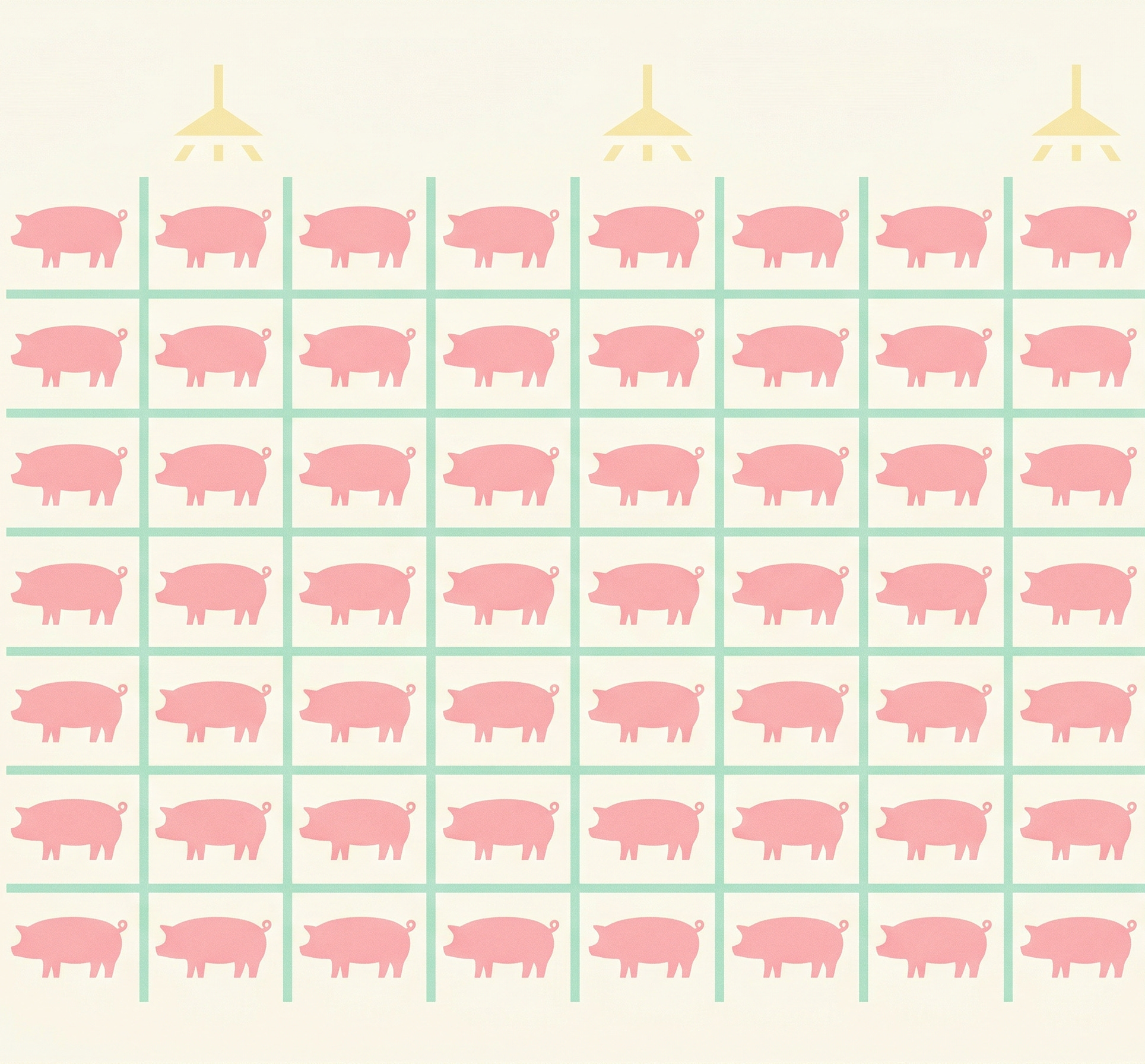
Fred loves chocolate. Two years ago, a car accident damaged a gland in his brain, and now chocolate tastes like cardboard. His neurologist tells him there’s one fix: a hormone called cocoamone, which can only be harvested from the brains of puppies that have been subjected to weeks of severe pain. So Fred sets up twenty-six small wire cages in his basement. He slices off their noses and paws with a hot knife, without anesthesia. After six months of this, he butchers each puppy while holding it upside down. The cocoamone floods his bloodstream, and for one glorious week, chocolate tastes like chocolate again.
Fred is, obviously, a monster.
This scenario is a thought experiment by the philosopher Alastair Norcross, and when people encounter it for the first time, their moral reaction is instant and unambiguous. Fred is a disgrace. No quantity of chocolate pleasure could justify what he does. If you saw a news story about a man torturing puppies in his basement for any reason, you would want him in prison (or worse). This intuition is rock-solid. Nobody argues about it.
Norcross’s question is simple: what is the difference between Fred and you?
You, reading this, probably eat meat. The animals who become your chicken sandwiches and pork chops are not puppies, but they are creatures with nervous systems, social bonds, and the capacity to suffer in ways that would make Fred’s basement look like a day spa. The pleasure you get from eating them is, on the scale of things that matter in a human life, roughly equivalent to Fred’s pleasure from tasting chocolate: real, but trivial compared to the suffering that produces it. And unlike Fred, who tortures twenty-six puppies at a time, the system you participate in tortures and kills around 90 billion land animals per year.
If you think Fred is a monster, you have a problem. Because the argument that eating factory-farmed meat is morally wrong is, I think, about as strong as moral arguments get. It does not require you to accept any exotic philosophical framework, or to believe that animals are as valuable as humans. It requires only premises that you already buy, applied consistently.
I ate meat for much of my life. Until about ten years ago, I ate it enthusiastically and without much thought. Writing this is partly an act of self-indictment. But the arguments below changed my mind, and I think they should change yours too. I am going to lay them out as clearly as I can, address the strongest objections I know of, and let you decide what to do with them. If you’d rather watch an equally good case, check out: Bentham's Bulldog and Joe Schmid in this video.
What Happens in the Basement
The reason most philosophical arguments for vegetarianism and veganism begin with production rather than consumption is that the facts about production do most of the moral work. Once you know what actually goes on inside factory farms, the question is less “is this wrong?” and more “how have we organized an entire civilization around pretending this isn’t?”
Start with chickens, since they are the most numerous victims. More than 70 billion chickens are raised for meat globally each year, and the vast majority of them live in windowless sheds packed with 20,000 to 30,000 other birds. A broiler chicken in a typical American facility gets roughly 0.75 square feet of floor space, about the area of a sheet of printer paper. These birds have been selectively bred to reach slaughter weight in about six weeks, packing nearly twice the body mass into that time as birds did half a century ago. Their bodies grow so fast that their skeletons cannot keep up. A significant percentage of broiler chickens develop painful leg disorders; many become unable to walk at all and die of dehydration because they cannot reach the water line. They live on floors coated in their own waste. Ammonia from the urine burns their eyes and skin. Between 25 and 70 percent of birds in a given flock develop hock burns or footpad dermatitis, which is the clinical term for open sores caused by standing in excrement.
Laying hens have it differently bad. In conventional facilities, they spend their lives in battery cages, wire enclosures so small that a hen cannot spread her wings. To prevent the stress-induced pecking and cannibalism that inevitably results from cramming birds together in tiny cages, the tips of their beaks are cut off with a hot blade or infrared beam, without anesthesia. (The beak is a sensitive organ, densely innervated. Imagine having the end of your finger sliced off.) Male chicks, useless to the egg industry, are killed within hours of hatching. The standard methods include grinding (a high-speed macerator) and gassing. Hundreds of millions of male chicks meet this fate every year. The hens themselves are slaughtered at around 18 months, when their egg production declines, having lived about a quarter of their natural lifespan.
Pigs are, by most measures of cognition, smarter than dogs. They can learn their names, play simple video games, and use mirrors to locate hidden food. In factory farms, breeding sows spend most of their lives in gestation crates: metal enclosures approximately two feet by seven feet, too small for the animal to turn around. The sow can stand up and lie down. That is the full range of her physical existence for the roughly four months of each pregnancy, repeated over several years until her body gives out and she is sent to slaughter. When piglets are born, they are subjected to a set of terrible procedures within their first week of life: tail docking (cutting off most of the tail), ear notching (cutting chunks from the ears for identification), teeth clipping, and, for males, castration. All of these procedures are performed without anesthesia. This is standard practice in the United States, not an aberration.
I am aware that this section is unpleasant. That is the whole point. Michael Huemer, in his Dialogues on Ethical Vegetarianism, has one of his characters ask not to hear more about factory farming while they are eating. The other character responds: “But you don’t have any problem with eating the products that come from these practices?” There is something worth pausing over in the fact that the descriptions of what we do to animals are so disturbing that we cannot bear to read them while consuming the outcome of those very practices.
A natural escape hatch here is to say: “Fine, factory farming is terrible. I’ll just buy free-range.” The problem is that “free-range” is mostly a fiction. In the United States, the USDA labeling standard for “free-range” poultry requires only that producers demonstrate the birds were “allowed access to the outside,” which in practice can mean a small door at the end of a shed that 20,000 chickens never use. Even on farms that do better than the minimum required for the label, animals typically go to the same industrial slaughterhouses as factory-farmed animals, enduring the same stressful transport and the same violent deaths. And even on the best imaginable farm, you are still killing a sentient creature at a fraction of its natural lifespan because you prefer the taste of its body to a bean burrito. The gap between the best-case farm and Fred’s basement is far smaller than the meat industry’s marketing departments want you to think.
The Argument You Already Accept
The core moral argument against factory farming requires only three premises, and you already believe all of them.
Premise one: suffering is bad. Not just human suffering. If you saw someone beating a dog in a parking lot, you would not think “well, it’s only a dog” and walk away. You would be horrified, and you would think the person doing it was doing something extremely wrong. The badness of suffering comes from what it feels like, not from the species membership of the creature experiencing it.
Premise two: it is wrong to cause enormous suffering for trivial reasons. This is the principle that condemns Fred. Fred’s reason (chocolate pleasure) does not come close to justifying the suffering he inflicts (months of agony for twenty-six puppies). You accept this. Everyone accepts this.
Premise three: buying factory-farmed meat causes (or supports, or participates in) enormous suffering for trivial reasons. The suffering part is established by everything in the previous section. The “trivial reasons” part is the taste pleasure you get from eating meat rather than the alternatives. You do not need meat to survive. You do not need it to be healthy. (The American Dietetic Association has stated that well-planned vegetarian and vegan diets are nutritionally adequate for all stages of life.) What you get from meat is that it tastes a certain way, and that eating it is culturally convenient. That is legitimate, but it is not enough to justify what occurs in the sheds and the slaughterhouses.
If those three premises are true, the conclusion follows: buying factory-farmed meat is morally wrong.
The interesting philosophical action is in trying to deny one of these premises, and the striking thing is how difficult that turns out to be. The attempts collapse, one after another, in ways that are instructive about how our moral reasoning works.
“Animals Aren’t Smart Enough to Matter”
The most popular attempt to resist the argument appeals to intelligence. Humans are rational, self-aware creatures capable of language, abstract thought, and moral reasoning. Animals are not. Surely this difference justifies treating them differently.
The question is: how? What is the connection between intelligence and the badness of suffering? If you have a headache and Einstein has the same headache, his does not hurt more because he is smarter. Pain is pain. Its badness is a feature of what it feels like, not of how many digits of pi the sufferer can recite. The intelligence defense tries to make cognition do moral work that it is not equipped to do.
But the real problem with the intelligence defense is what Norcross calls the “argument from marginal cases,” and it is the single most powerful objection in this debate. It goes like this:
Some human beings are severely cognitively disabled. Some have less cognitive capacity than a healthy adult pig. If the reason it is acceptable to torture pigs is that they lack human-level intelligence, then it should also be acceptable to torture these humans. They fail the cognitive test just as badly as the pig does. Worse, in some cases.
If you find this conclusion very dumb and clearly wrong (and you do), then intelligence cannot be the thing that makes suffering matter. You need a different account of why these humans are protected, and whatever account you give is almost certainly going to protect the pig too. Maybe you say that suffering is wrong because of what it feels like. Great; the pig suffers too. Maybe you say that all humans are protected because they belong to a species that is normally rational. But why should the moral status of my pain depend on the cognitive abilities of other members of my species? If a large number of severely disabled humans were born tomorrow, lowering the average intelligence of Homo sapiens, would it suddenly become permissible to torture me? The question answers itself.
Huemer walks through this exact dialectic in his dialogues, and watches the meat-eater’s position collapse in real time. First the meat-eater claims animals lack moral status because they lack intelligence. Then, confronted with the marginal cases problem, he invents a “threshold” of intelligence above which suffering matters and below which it doesn’t. Then, asked what the threshold is, he cannot specify it. Then, asked why the threshold falls conveniently between the dumbest human and the smartest farm animal, he appeals to species membership. Then, asked why species membership would determine the badness of pain, he has no answer. The position is not defended; it is constructed on the fly to justify a conclusion that was decided in advance.
“But I Can’t Make a Difference”
This is the causal inefficacy objection, and it is the most serious challenge to the argument. Even if factory farming is wrong, the objection goes, your individual purchasing decision makes no difference to the industry at all. McDonald’s will slaughter the same number of cattle whether you buy a burger or not. The system is too large to respond to a single consumer. So while factory farming may be a moral catastrophe, your participation in it is morally harmless, much like casting a single vote in a national election.
This objection has force, and the philosophers who take it seriously (Mark Budolfson and others) are not fools. But I think it ultimately fails for several independent reasons.
The first is the expected utility argument, elegantly laid out by Norcross and expanded by others. Yes, one person giving up chicken probably does not reduce production. But there is some number of people, call it n, whose collective abstention would cause the industry to reduce output. If n is 10,000, then your individual decision has a one-in-10,000 chance of triggering a reduction that spares 250,000 chickens. A one-in-10,000 chance of preventing 250,000 chickens from living in agony has real moral weight: it is the mathematical equivalent of certainly saving 25 chickens per year. We accept this kind of probabilistic reasoning everywhere else. We do not let airlines fly with broken emergency exits just because the odds of needing them on any given flight are tiny. We do not let parents skip car seats because most car trips end safely.
Agricultural economists have also studied this empirically. Norwood and Lusk, in Compassion, by the Pound, estimate that if you reduce your meat purchases by one pound, producers decrease their production by 0.68 pounds (for beef), 0.76 pounds (for chicken), or 0.74 pounds (for pork). The market does not perfectly offset your abstention. But it substantially responds to it.
The second response to the causal inefficacy objection does not rely on consequentialist reasoning at all. Norcross offers a sharp version of it. Modify the Fred scenario: suppose that instead of one man, an entire industry tortures puppies to produce cocoamone, and the industry is so large that your individual purchase of cocoamone-chocolate makes no difference to its operations. Would you buy the chocolate? Even knowing that the same number of puppies will be tortured whether you buy it or not?
I think the answer is obviously no, and the reason has nothing to do with consequences. It has to do with complicity. Financially rewarding an enterprise that you know to be monstrous is wrong, even if your individual dollars do not change its behavior. Imagine being offered a job loading people into gas chambers in Nazi Germany. The job pays slightly more than your current one. If you decline, they will hire someone else, and the same people will die. Are you justified in taking the job? The horror of this scenario is immediate, and it concerns what you become by participating, not whether your refusal would have changed the outcome.
As Huemer puts it: “You’re not necessarily obligated to fix the world’s injustices, but you are obligated not to become a part of them.”
“These Animals Would Never Have Existed Without Us”
This objection, sometimes called the “replaceability argument” or the “logic of the larder,” goes like this: the animals on factory farms were bred for the purpose of being eaten. If we stopped eating meat, they would never have been born. Surely existence, even a bad existence, is better than non-existence?
The answer is obviously no. A life of confinement in a gestation crate, of chronic pain from bones buckling under the body’s own weight, of having sensitive tissue cut off without anesthesia, of being killed at a fraction of one’s natural lifespan: this is worse than non-existence, and most people who look squarely at the conditions would agree. Norwood and Lusk, who are agricultural economists and not animal rights activists, rate the lives of battery-caged laying hens as not worth living. The animals themselves, if they could choose, would not choose this.
And even setting aside the quality-of-life question, the logical structure of the argument is terrifying when applied consistently. It would justify breeding humans as organ farms. After all, those humans would not have existed without the organ-farming program. Their existence, even if it involves being raised and killed for parts, is “better than nothing.” If you balk at this conclusion (and you should), you cannot use the same logic to justify factory farming.
There is a deeper point here that the suffering-focused argument sometimes obscures: killing, not just hurting, is part of the moral problem. Even if you could eliminate every moment of pain from an animal’s life and dispatch it instantly and painlessly, you would still be destroying a creature that has preferences, social bonds, and an interest in its own continued existence, all for the sake of a particular taste. The wrong of factory farming is not only that it tortures; it is that it kills beings who should have lives worth continuing.
“Eating Meat Is Natural”
Yes, it is. Humans have eaten meat for hundreds of thousands of years. We have canine teeth. Our ancestors hunted.
War is also natural. Infanticide occurs in many species. Rape has been documented across the animal kingdom. “Natural” is not a synonym for “morally permissible.” Our entire project as a civilization is to override many of our natural impulses with better ones. You are probably reading this essay on a digital screen while sitting in a climate-controlled room, wearing synthetic fabric, and possibly sipping a beverage that was shipped across an ocean. Natural is not the standard you apply to anything else in your life.
If what you mean by “natural” is that humans have always done it, then you have just made an argument for the permissibility of every practice that has survived across human history, including plenty that you find abominable.
“Animals Eat Other Animals”
Lions eat gazelles; cats eat mice. The food chain is red in tooth and claw. If animals eat each other, how can it be wrong for us to eat them?
This argument fails because lions are not moral agents. A lion cannot deliberate about the ethics of its behavior, form intentions based on moral principles, or choose to act otherwise. You can. That is the difference. We do not praise or condemn the lion for eating the gazelle any more than we praise or condemn a hurricane for destroying a town. Moral responsibility requires the capacity for moral reasoning, and you have it. The lion’s diet is no more relevant to the ethics of your diet than the lion’s mating habits are relevant to the ethics of your sex life.
“Animals Can’t Reciprocate, So They Don’t Have Moral Standing”
This is the contractualist version of the moral agency objection, and it is more sophisticated. The idea is that morality is fundamentally a contract among beings who can cooperate, make promises, and hold each other accountable. Animals cannot do any of this, so they fall outside the scope of moral consideration. Peter Carruthers defends a version of this view.
The problem is the same as before: marginal cases. Infants cannot enter contracts. Neither can humans with severe cognitive disabilities. If the ability to reciprocate is what generates moral standing, these humans have none. You would be permitted to experiment on them, harvest their organs, or eat them. No one accepts this. And once you expand the contract to cover beings who cannot reciprocate (as every serious contractualist does, including Rawls), you have already conceded that reciprocity is not actually the criterion. At that point, the principled barrier against including sentient animals has collapsed.
“What About Plants?”
There are various versions of this objection. The simplest is: “Plants are alive too. If you’re worried about causing harm to living things, you should stop eating plants.” But the argument for vegetarianism is about suffering, not about life. Plants do not have nervous systems. They do not have brains. There is no scientific basis for attributing the capacity for pain to a tomato. The reason suffering matters is that it involves a subjective experience of distress, and subjective experience requires, at minimum, the kind of neural architecture that plants clearly do not possess.
A more sophisticated version of the objection: plant agriculture also kills animals. Harvesting crops kills mice, moles, insects, and other small creatures. This is true, but the argument against factory farming does not require that plant agriculture be morally perfect. It requires only that factory farming is much worse, which it obviously is. Factory farming requires massive crop production to feed the animals, plus all the suffering of the animals themselves. If your concern is minimizing total animal suffering and death, eating plants directly rather than filtering them through animal bodies is the clear winner.
Moral Uncertainty and the Ethics of Risk
Even if you are not fully persuaded by everything above, there is a further argument that should give you pause. Call it the argument from moral uncertainty.
You do not need to be certain that animals’ suffering matters morally in order for eating meat to be wrong. You just need to assign some non-trivial probability to the proposition that it matters. And the probability here is not small. There is a long philosophical tradition, from Bentham through Singer, holding that the capacity to suffer is the morally relevant property. There is strong scientific evidence that farm animals feel pain through the same physiological mechanisms that produce pain in humans. The case that animal suffering matters is at least as plausible as the case that it doesn’t.
Huemer makes the point with more mathematical precision. If there is even a 1% chance that Peter Singer is right that animal suffering is morally equivalent to human suffering, then the meat industry is as bad as a practice that has a 1% chance of torturing 80 billion people a year. A 1% chance of torturing 80 billion people is morally equivalent to the certainty of torturing 800 million. That number is staggering, even as a risk-adjusted estimate.
And the case for dismissing animal suffering turns out to rely on a tower of increasingly specific and unjustified claims: that the badness of pain depends on intelligence, that there is a sharp threshold above which pain suddenly matters a million times more, that this threshold conveniently falls between humans and all farm animals, that it sometimes depends on the average intelligence of one’s species rather than on one’s own intelligence. If you need all of these things to be true to justify your current behavior, you should be deeply uncertain.
When the stakes are this high and the probability of error is non-trivial, caution demands that you stop.
Why We Don’t Stop
If the arguments are this strong, why do most people keep eating meat? The answer is not that the arguments are weak. The answer is that human psychology is very good at protecting comfortable habits from rational scrutiny. Which biases matter most?
Status quo bias: we are strongly inclined to believe that whatever we are currently doing is acceptable, simply because we are currently doing it. This is the moral equivalent of concluding that the bar you are sitting in must be the best bar in town because you are already there.
Speciesism: we instinctively weight human interests over animal interests, for no well-examined reason beyond the fact that the animals are them and we are us. This is bias in the most literal sense. If the same suffering were inflicted on creatures that looked like us, or that we had personal relationships with, we would recognize it as an atrocity immediately. The moral status of puppies in Western culture versus the moral status of equally intelligent pigs illustrates this perfectly.
Social conformity: nearly everyone around you eats meat. Departing from the prevailing practice requires active effort and social friction. We are herd animals, and our herd eats animals.
Self-interest bias: meat is pleasurable and convenient. You have every personal incentive to believe that eating it is fine, and your brain is happy to oblige by filtering out inconvenient moral information. Huemer’s character M in the dialogues introspects for three seconds and announces that he has confirmed he is unbiased. Played for laughs, but it is exactly what we all do.
The distraction maneuver: when confronted with the argument, most people do not engage with the actual question (is it wrong to cause enormous suffering for trivial pleasure?). Instead, they shift to a neighboring question: can animals really suffer? What about plants? What if you were on a desert island? Is it wrong to eat roadkill? What is the correct meta-ethical theory? These are all interesting questions. None of them change the answer to the first question, and the impulse to raise them is itself diagnostic of the kind of avoidance that the argument predicts.
So What Should You Do?
I am not going to tell you that I have a perfect track record. I ate meat for two decades. I still occasionally fail to check ingredients carefully enough. Moral consistency is hard, and purity is not the standard.
But the arguments point in a clear direction. Factory farming is an ongoing moral catastrophe, comparable in scale to the worst things human beings have ever done to one another. It also happens to be an ecological disaster: a leading driver of deforestation, water pollution, and greenhouse gas emissions. The Food and Agriculture Organization (FAO) estimates that livestock supply chains alone account for about 14.5 percent of all human-caused greenhouse gas emissions. You know this is wrong because you cannot bear to watch videos of it, because you instinctively look away from descriptions of it, because the entire system depends on the invisibility of what occurs inside windowless buildings scattered across the countryside. The philosophical arguments confirm what your gut already tells you: this is wrong, and participating in it by purchasing its products is wrong too. Set aside the utilitarian calculus for a moment and ask a simpler question: what kind of person finances this with a clear conscience?
You do not have to become a perfect vegan overnight. You do not have to solve every edge case before taking the first step. The argument from moral uncertainty alone is sufficient: if there is any significant chance that this system is as bad as the evidence suggests, continuing to support it is an indefensible gamble.
I think you already know this. The question is whether you are willing to let that knowledge change what you do.
Puppies are different because we have an evolutionary deal with dogs. They care about our emotions and we care about theirs. The evolutionary deal we have with pigs and chickens is that we kill and eat them.
"Fred is, obviously, a monster."
I simply did not have this reaction to reading about Fred's actions.